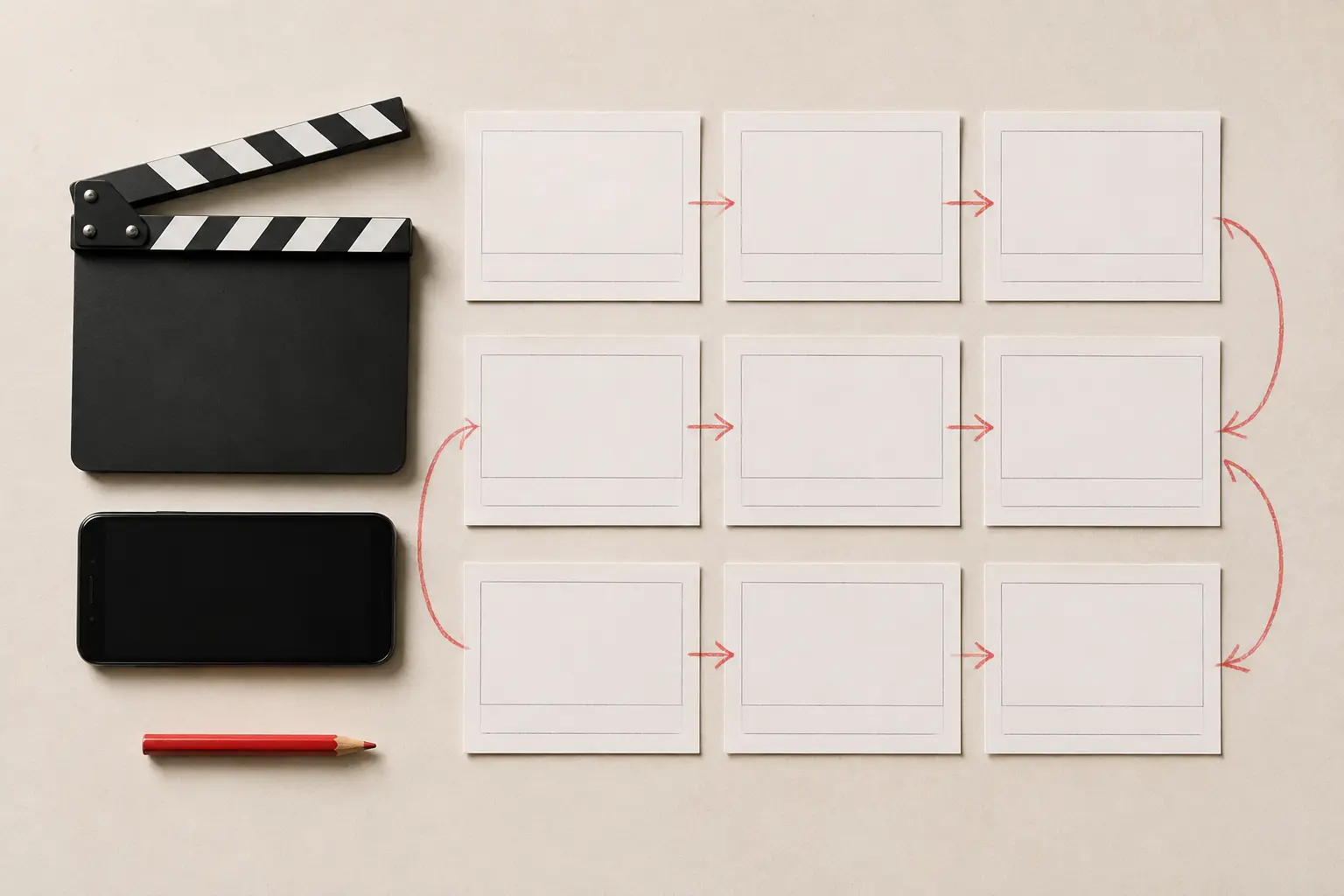
Producing 15 or more Reels in one production day is not about filming faster. It is about planning smarter before the camera starts rolling.
For busy marketing teams, founders and in-house teams, one of the biggest social media challenges is maintaining a consistent supply of quality content without organising a new shoot every week.
The answer is not always more production days.
With the right pre-production system, one well-planned shoot can generate educational videos, product content, paid-ad variations, FAQs, short-form Reels and reusable B-roll.
Scalable content production starts before the shoot — not with improvisation on set.
Why Shooting “On the Fly” Usually Creates Less Content
A common approach is to arrive with a few general ideas and decide what to film as the day progresses.
It feels flexible, but it often wastes production time.
The team starts asking:
• What should we film next?
• Who needs to be on camera?
• Which product should we prepare?
• What should the talent say?
• Do we need another angle?
• Did we already capture this shot?
When those decisions are made during the shoot, the camera spends more time waiting than filming.
Production day should be for execution. Most important creative decisions should already be made.
Step 1: Build a Content Matrix Before Writing Scripts
Before writing individual scripts, identify the different types of content the brand actually needs.
Instead of treating every Reel as a completely separate production, organise topics into repeatable categories.
EDUCATIONAL
FAQs, mistakes, tips, comparisons and buying guides.
PRODUCT
Features, demonstrations, benefits and close-ups.
BRAND
Team, process, behind-the-scenes and company positioning.
CONVERSION
Offers, testimonials, objections and direct-response ads.
Once these categories are clear, it becomes much easier to identify 15, 20 or even more usable ideas without making the content feel random.
Step 2: Turn Topics into a Script Matrix
Writing every Reel from scratch is slow, especially when several videos follow a similar structure.
A more efficient approach is to use a repeatable script framework:
HOOK
Give the viewer a reason to stop.
VALUE
Explain the key idea quickly.
PROOF
Show the product, example or visual evidence.
CTA
Tell the audience what to do next.
This keeps the content structured while making it faster to prepare multiple scripts.
Step 3: Group Videos by Talent, Location and Setup
Production becomes much more efficient when the schedule is organised around setups instead of filming one whole video at a time.
Less efficient:
Video 1 → change location → Video 2 → reset lighting → Video 3 → bring product back → Video 4.
More efficient:
Film all Talent A talking scenes → all Product A shots → all warehouse B-roll → all close-ups.
This reduces time spent moving lights, resetting cameras, preparing products and briefing the same talent repeatedly.
Step 4: Prepare a Detailed Shot List
Scripts explain what needs to be communicated. Shot lists explain what the production team needs to capture.
A useful shot list can include:
• Talking-head shots
• Wide environmental shots
• Medium product demonstrations
• Close-up product details
• Hands using the product
• Staff interactions
• Process footage
• Location establishing shots
• Customer-perspective shots
• Extra B-roll for future edits
A strong shot list reduces the chance of reaching post-production and discovering that an important visual is missing.
One Master Idea Can Become Multiple Content Variations
One filming setup does not have to produce only one final video.
The same core footage can often become several versions:
ORGANIC REEL
Educational hook + natural CTA.
PAID AD
Stronger pain point + offer-driven CTA.
SHORT CUTDOWN
10–15 second version focused on one idea.
REMARKETING VERSION
Proof, testimonial or objection-focused angle.
This works best when the variations are planned before the shoot, not invented after all filming is finished.
Capture Multiple Hooks While the Camera Is Rolling
The hook is one of the easiest things to vary during production.
Instead of recording one opening line, record three or four before moving on.
For example:
HOOK A
“Still struggling to post consistently every month?”
HOOK B
“You don’t need 15 production days to create 15 Reels.”
HOOK C
“Here’s how we plan one shoot to create weeks of content.”
These extra hooks give editors more flexibility and create useful creative-testing options later.
Capture B-Roll That Can Work Across Multiple Videos
B-roll should not only support the exact video being filmed at that moment.
A good production day should also build a reusable visual library.
For a factory or industrial shoot, that could include:
• Exterior building shots
• Warehouse movement
• Staff working
• Machines operating
• Products being packed
• Close-ups of components
• Forklift movement
• Installation preparation
• Team discussions
Those clips can support future educational videos, brand videos, ads and sales content.
Plan for Different Aspect Ratios Before Editing
The same content may eventually be used across several platforms.
That means framing should already consider different placements during production:
9:16
Reels, Stories and vertical social content.
16:9
Websites, presentations and wider video placements.
1:1
Selected feed and advertising placements.
If everything is framed too tightly for one format, important elements may be cut off when the content is repurposed.
Post-Production Needs a System Too
Producing 15 videos is only useful if the editing workflow can handle the volume.
A scalable post-production system should organise footage by:
• Content topic
• Talent
• Product
• Camera angle
• B-roll category
• Platform format
• Final export version
A practical workflow is:
01 ORGANISE
Sort footage and label assets.
02 MASTER EDIT
Build the strongest main version first.
03 VARIATIONS
Duplicate and adjust hooks, CTAs and durations.
04 EXPORT
Prepare the required ratios and platform versions.
The Production Day Should Follow a Schedule
Once scripts, shot lists and setups are confirmed, production should run more like a planned schedule than an open-ended creative session.
A sample day might look like:
08:00 – 09:00
Setup & lighting
09:00 – 11:00
Talking-head content
11:00 – 13:00
Product demonstrations
14:00 – 16:00
B-roll & lifestyle shots
16:00 – 18:00
Variations, pickups & backup
The exact timing depends on the project, but having a schedule keeps the team aligned.
Batch Production Does Not Mean Every Reel Should Look the Same
Efficiency should not remove creativity.
The goal is to reduce repeated setup work, not to produce 15 identical videos.
Variety can still come from:
• Different hooks
• Different camera angles
• Different talent
• Product demonstrations
• POV formats
• Voice-over videos
• Educational formats
• Faster direct-response cuts
• More polished brand-led edits
What Should Be Ready Before Production Day?
To maximise the number of usable videos from one shoot, prepare as much as possible in advance:
• Content topics confirmed
• Scripts or talking points approved
• Shot list completed
• Talent schedule confirmed
• Products prepared
• Locations ready
• Props and wardrobe confirmed
• Camera and lighting requirements planned
• Multiple hooks prepared
• CTA variations prepared
• Platform formats considered
More Content Does Not Require More Chaos
Batch production works because decision-making happens before production day.
When the content matrix, scripts, talent, shot list and post-production requirements are clear, the production team can focus on capturing strong footage efficiently.
The result is not simply “more videos”.
It is a more scalable content system where one production day can support weeks of social content, advertising and reusable brand assets.
Plan once. Shoot strategically. Repurpose with purpose.
