The True Cost of Juggling Multiple Agencies (And Why All-in-One Creative Works Better)
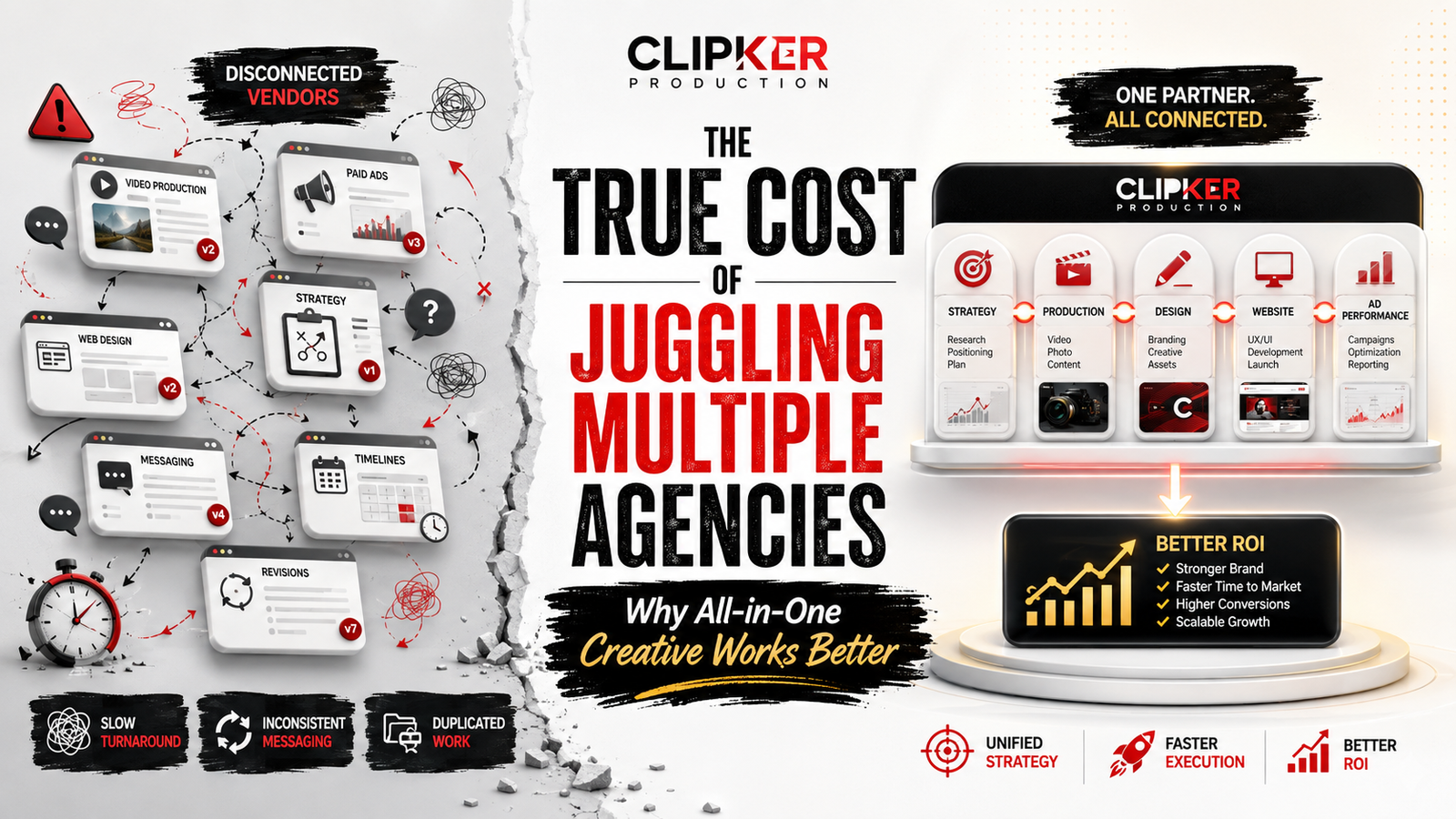
Hiring different specialists for video production, social media, advertising and website design can look efficient on paper. In practice, the hidden cost is often coordination.
One agency develops the campaign strategy. Another team shoots the video. A designer prepares the visual assets. A media buyer eventually receives everything and tries to turn it into advertisements.
Every vendor may be good at what they do individually, yet the campaign can still feel disconnected.
Messaging changes between teams. Deadlines depend on multiple schedules. Feedback gets repeated. Important context gets lost during handovers. And creative assets may only be evaluated for advertising performance after production has already finished.
What Managing Multiple Agencies Actually Looks Like
Imagine a business planning a new campaign.
The marketing team may need to coordinate:
- A strategy or branding consultant
- A video production company
- A photographer
- A graphic designer
- A website developer
- A social media team
- A Meta or Google Ads agency
Every supplier requires a brief. Every supplier has a different timeline. Every supplier may interpret the campaign differently.
Suddenly, the internal marketing manager is no longer only managing marketing.
They are managing the relationships between multiple external teams.
The same campaign objectives need to be explained repeatedly to different vendors.
Files, feedback and strategic context move from one team to another.
One delayed deliverable can hold back every team further down the chain.
Each vendor may optimise their own deliverable without seeing the full campaign journey.
The Biggest Problem Is Usually Not Talent — It Is Translation
A production company may be focused on creating beautiful footage.
A performance marketing agency may be focused on click-through rate, lead quality and cost per acquisition.
A web designer may be thinking about page structure, responsiveness and visual hierarchy.
None of those priorities are wrong.
The problem appears when each team starts working independently instead of from the same campaign strategy.
“We need a beautiful 60-second brand video.”
“We need three hooks, a 15-second cutdown, product proof and several CTA variations.”
If the performance requirements only reach the production team after filming is complete, it may already be too late.
The correct opening shots may not exist. The talent may not have recorded alternative hooks. There may be no clean product close-ups. And the final footage may be difficult to adapt into shorter advertisements.
Disconnected Teams Can Create Inconsistent Brand Messaging
A campaign should feel like one conversation with the customer.
The advertisement, video, landing page, caption and enquiry experience should reinforce the same message.
But when several independent teams work without one shared creative direction, the customer may see:
- One message in the video
- Another message in the ad copy
- Different visuals on the landing page
- A different offer in the sales material
- Different terminology across platforms
None of these differences may look serious on their own, but together they weaken the campaign.
Multiple Vendors Can Slow Down Campaign Execution
More vendors also means more dependencies.
The ad team may be waiting for the video. The web team may be waiting for photography. The designer may be waiting for final campaign copy. And the production team may be waiting for feedback from several stakeholders.
Even when everyone is responsive, coordination itself creates additional steps.
MORE HANDOVERS
ONE CONNECTED WORKFLOW
What Changes When Strategy and Production Work Together?
When the same creative partner understands both production and campaign execution, pre-production can start with the end goal.
Instead of simply asking:
the team can ask:
That changes how the production itself is planned.
The shoot may intentionally include:
- Multiple opening hooks
- Several CTA variations
- Vertical and horizontal framing
- Product close-ups
- Customer pain-point scenes
- Testimonials
- Short B-roll sequences
- Website hero footage
- Paid-ad cutdowns
One production day can then support more than one deliverable.
One Campaign Should Create an Asset System, Not One Video
A common production mindset is:
An integrated creative approach can instead think:
Main campaign or brand story.
Organic social content and educational cutdowns.
Different hooks, CTAs and direct-response angles.
Campaign visuals, social posts and web assets.
A focused destination matched to the campaign.
Proof, testimonials and objection-handling assets.
Creative Can Be Built for Performance from Day One
One major benefit of connecting production with performance marketing is that advertising requirements can shape creative decisions early.
For example, if a campaign needs multiple ad variations, the production plan can intentionally capture:
- Three different hooks
- Two opening visuals
- Different customer pain points
- Short and long CTA versions
- Several product demonstrations
Editors can then produce controlled creative variations without organising another shoot.
Lead with the customer’s biggest problem.
Start with the desired outcome.
Start with a result, project or demonstration.
Your Website Should Not Be an Afterthought Either
A strong advertisement can still underperform if the visitor reaches a page that does not continue the same message.
This is another place where disconnected vendors can create friction.
The ad agency may optimise one offer, while the website still talks broadly about the company.
When web and advertising strategy are connected, the landing page can be built specifically around:
- The same headline as the campaign
- The same visual direction
- The same customer problem
- The same offer
- Relevant proof and case studies
- One clear enquiry path
Where the ROI Opportunity Actually Comes From
Working with one integrated creative partner does not automatically guarantee lower costs or better campaign results.
The potential efficiency comes from reducing duplicated work and getting more usable assets from the same strategy and production investment.
For example, instead of separately budgeting for:
- A brand video
- Social Reels
- Ad creative
- Product photography
- Landing-page visuals
some of those needs can be planned together during one campaign production.
One strategy can guide several deliverables.
Footage can support social, ads and web.
Creative learnings can feed directly into new variations.
Brand, creative and campaign goals stay connected.
One Partner Also Means One Source of Accountability
When several vendors are involved, performance problems can become difficult to diagnose.
The media buyer may say the creative is weak. The production team may say the targeting is wrong. The website developer may say traffic quality is the issue.
The business owner ends up trying to determine which explanation is correct.
An integrated workflow creates clearer ownership because the same team can look across the full journey:
Did the creative stop the scroll?
Did the message create enough interest?
Did the destination match the advertisement?
Was the enquiry journey clear and friction-free?
Does Every Business Need an All-in-One Agency?
Not necessarily.
There are situations where specialist agencies make perfect sense.
A large company may already have an experienced internal marketing team capable of coordinating multiple specialist partners.
A highly technical project may also require a niche specialist with expertise in one specific area.
The question is not simply whether one agency or multiple agencies are objectively better.
The better question is:
For businesses with limited marketing resources, an integrated partner can reduce the amount of project management required internally.
When an Integrated Creative Partner Makes the Most Sense
An end-to-end approach can be particularly useful when:
- Your marketing team is small or already overloaded
- You regularly need video, design and advertising together
- Your campaigns are delayed by vendor coordination
- Your brand messaging feels inconsistent across channels
- Your production team does not understand paid-media requirements
- Your ad agency constantly asks for new creative variations
- Your website and advertising campaigns feel disconnected
- You want to reuse production assets across multiple platforms
A Better Workflow Starts Before Production
The biggest advantage of an integrated creative model is not simply having more services available from one supplier.
It is having those services influence one another from the beginning.
Define audience, message, offer and campaign objective.
Plan scripts, hooks, shot lists and required formats.
Capture master assets and modular variations.
Adapt assets for social, ads, website and landing pages.
Use campaign learnings to guide the next creative cycle.
The Goal Is Not Fewer Vendors. It Is Less Friction.
Businesses should work with the partners that best fit their needs.
But if managing multiple agencies is consuming more time than the marketing itself, the structure may need to change.
Creative, production, digital experience and media execution increasingly influence one another.
Connecting them earlier can create a smoother workflow, clearer brand messaging and more reusable campaign assets.
BRING STRATEGY, CREATIVE & EXECUTION
UNDER ONE CONNECTED WORKFLOW.
Clipker combines video production, social content, performance marketing, photography and website support to help businesses build campaigns with fewer handovers and a clearer creative direction.
TALK TO CLIPKER ↗